

Medically reviewed by Dr. L. Bharath , Consultant Orthopaedic Surgeon, Bharath Orthopaedics
Knee replacement surgery has one of the highest patient satisfaction rates of any elective orthopaedic procedure. Most people who have it done say they wished they had done it sooner. But the outcome depends not just on what happens in the operating theatre, and it depends significantly on what happens in the weeks and months afterward.
Recovery from knee replacement follows a predictable pathway when patients follow the right guidance. When they do not, complications that were entirely preventable can set recovery back by weeks or cause lasting problems with function.
What are the Top 5 Mistakes after Knee Replacement?
The five most common mistakes that slow recovery or cause complications after knee replacement are: not moving enough in the early days, stopping physiotherapy too early, doing too much too soon, not managing swelling consistently, and ignoring warning signs of complications. Each of these is explained in detail below with specific guidance on what to do instead.
Mistake 1: Not Moving Enough in the First 48 Hours
This is the mistake that surprises most patients. The instinct after major surgery is to rest completely and protect the joint. In knee replacement, the opposite approach is correct.
Modern fast-track knee replacement protocols get patients walking on the day of surgery. This is not about pushing through pain; it is about preventing two serious post-operative complications: deep vein thrombosis (DVT) and joint stiffness.
Blood clots in the leg veins are a genuine risk after knee replacement. Movement of the calf and foot muscles acts as a pump that keeps blood circulating through the deep veins. Patients who lie still for extended periods in the first 48 hours have a measurably higher risk of DVT.
Joint stiffness is the second issue. The scar tissue that forms around a healing joint begins to mature within days of surgery. Early movement prevents this tissue from forming in a way that restricts range of motion. A joint that does not move enough in the first week is significantly harder to rehabilitate at week four.
A common but often overlooked barrier to early movement is post-operative drowsiness and nausea from opioid pain medications. Standard surgical protocols that rely heavily on opioids leave patients too groggy and uncomfortable to move within the first several hours. The SMART Knee Replacement technique used at Bharath Orthopaedics addresses this directly through a non-opioid multimodal analgesia approach, which controls pain effectively without the sedation and nausea of opioids. This makes walking within 4 to 5 hours of surgery realistic and achievable for most patients.
What to do instead: Follow the nursing team and physiotherapist’s instructions precisely regarding when to get up and how far to walk. Do your ankle pumps and heel slides in bed between walking sessions. The goal in the first 48 hours is not strength; it is circulation and early range of motion.
Mistake 2: Stopping Physiotherapy Too Early
The second most common mistake is patients deciding they are recovered enough to stop formal physiotherapy once they can walk comfortably around the house. Walking without pain is not the endpoint; it is roughly the halfway point.
The full recovery from knee replacement takes 3 to 6 months, with subtle improvements in strength, balance, and comfort continuing for up to a year. The first 6 weeks are about regaining basic function. Weeks 6 to 12 are where strength, stability, and full range of motion are built. Patients who stop physiotherapy at week 4 because they feel better frequently plateau at a level of function well below what they could have achieved.
The quadriceps, the large muscle group at the front of the thigh, weakens significantly before surgery due to chronic pain limiting activity. This is compounded during surgery itself. Conventional knee replacement uses a pneumatic tourniquet around the thigh to reduce blood loss during the procedure. This tourniquet compresses the thigh muscles for the duration of surgery and contributes directly to post-operative muscle weakness and thigh pain. The SMART protocol avoids tourniquet use entirely, which means significantly less muscle trauma, less thigh pain in recovery, and faster quadriceps reactivation, but rebuilding full strength still requires consistent, progressive rehabilitation over months.
What to do instead: Complete the full physiotherapy programme prescribed by your surgeon. If you are discharged from formal physiotherapy but still have weakness or range of motion deficits, ask for a continuation. The exercises are not optional extras; they are central to the outcome.
Mistake 3: Doing Too Much Too Soon
Some patients, particularly those who are highly motivated and used to being active, push themselves too hard too early. They interpret pain as something to be pushed through rather than a signal to modify activity.
The implant is designed to remain stable, but the surrounding soft tissues still need time to heal. Overloading the healing joint in the first few weeks can cause excessive swelling, delay tissue recovery, and in some cases lead to complications. Common signs a patient is doing too much include significant increase in swelling by the end of the day, pain that is worse the following morning than the day before, and warmth over the knee that is not settling.
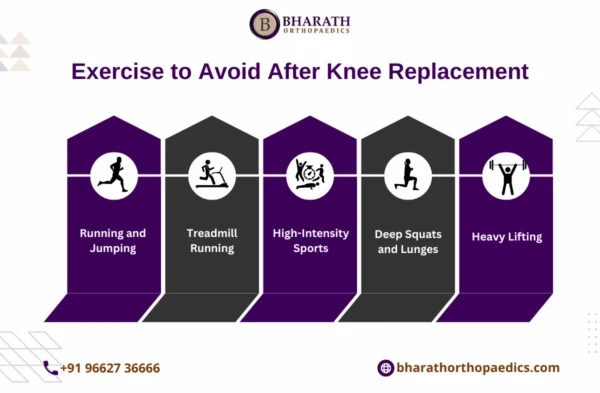
What to do instead: Follow the graduated activity programme given by your physiotherapist. As a general guide, if your knee is more swollen and painful after an activity than it was before, that activity was too much for that stage of recovery. Reduce it and build up more gradually. High-impact activities like running, jumping, and court sports should not be resumed until at least 3 to 6 months post-surgery and only with your surgeon’s clearance.
Mistake 4: Not Managing Swelling Consistently
Swelling after knee replacement is normal and expected; it can persist in some form for up to 3 to 6 months. What slows recovery is not the swelling itself but failing to manage it actively, because uncontrolled swelling delays range of motion and causes pain that discourages movement, creating a cycle that holds recovery back.
One specific and destructive error that many patients make is placing a pillow directly underneath the knee joint while resting or sleeping. This feels comfortable because it takes pressure off the area, but it holds the knee in a bent position for extended periods. Over time this can lead to a flexion contracture, a permanent inability to fully straighten the leg, which significantly impairs walking and function. Elevation pillows must support the entire lower leg and ankle, keeping the knee flat, not propped underneath it.
What to do instead: Elevate the leg above heart level for 20 to 30 minutes several times a day throughout the first 6 weeks, with support under the calf and ankle, not the knee. Apply ice or a cold compress for 15 to 20 minutes after physiotherapy sessions or any activity that increases swelling. Compression stockings as directed by your physiotherapist also help. If swelling increases suddenly, becomes very firm, or is accompanied by calf pain and redness, contact your surgeon immediately as these can be signs of DVT.
Mistake 5: Ignoring Warning Signs of Complications
Most complications after knee replacement are treatable when caught early. The problem is that patients sometimes dismiss or delay reporting warning signs, either because they assume some degree of discomfort is normal or because they do not want to trouble their surgeon.
The warning signs that always warrant prompt contact with your surgical team are:
- Increasing redness, warmth, or discharge from the wound
- Persistent fever above 38 degrees Celsius
- Sudden increase in pain not explained by increased activity
- Calf pain, tightness, or swelling suggesting DVT
- New painful clicking, clunking, or instability that was not present before
- Feeling that the knee is giving way under load
Infection after knee replacement is rare but serious. When caught in the early weeks it can often be treated without further surgery. Left untreated, it can require revision surgery and a significantly longer recovery.
What to do instead: Keep all follow-up appointments. If you notice any of the warning signs above between appointments, call the clinic rather than waiting for the next scheduled visit. Early reporting is always the right decision.
How Long Does Recovery Actually Take?
Understanding the realistic recovery timeline helps patients set appropriate expectations and avoid both under-activity and over-activity at each stage.
With the SMART fast-track approach used at Bharath Orthopaedics, recovery milestones are earlier than conventional surgery:
- Day of surgery: Walking begins within 4 to 5 hours of the procedure for most patients.
- Day 2: Most patients can walk independently to the bathroom without assistance.
- Day 10: Many patients are able to discard walking aids entirely by this point.
- Week 2 to 6: Progressive increase in walking distance, bending and straightening improving, stairs becoming manageable. Driving is usually possible at 4 to 6 weeks depending on which leg was operated on.
- Week 6 to 12: Building strength, returning to most daily activities, reducing reliance on any remaining walking support.
- 3 to 6 months: Full functional recovery and return to low-impact recreational activity including swimming and cycling. Subtle improvements in strength, balance, and how natural the knee feels continue for up to a year after surgery.
Red Flags that Need Immediate Attention
Some symptoms after knee replacement require same-day or emergency medical attention rather than waiting for a scheduled appointment:
- Sudden severe chest pain or shortness of breath (possible pulmonary embolism)
- Complete loss of sensation in the foot or lower leg
- The wound opening or significant fluid leaking from the site
- Fever combined with rapidly increasing redness around the wound
These are rare but time-sensitive. If any of these occur, go directly to the emergency department or call your surgeon immediately.
Getting the Best Outcome from Your Knee Replacement
Knee replacement is a highly effective procedure with excellent long-term outcomes when recovery is managed well. The implant will last 20 or more years in the majority of patients. What determines how well you function with that implant is largely how seriously you approach the rehabilitation process.
At Bharath Orthopaedics in Chennai, patients receive a structured fast-track recovery plan beginning on the day of surgery. Read more about the SMART Knee Replacement approach and what the recovery pathway looks like, or visit our Total Knee Replacement page for detailed information on the procedure itself.
For appointments or post-operative concerns, contact us via our contact page.
Key Points
- Warning signs including persistent fever above 38 degrees, wound redness, and calf pain should be reported promptly, not monitored at home
- Moving early after knee replacement prevents blood clots and joint stiffness. opioid-free pain management makes this possible from the first few hours
- Complete the full physiotherapy programme, not just until you can walk around the house; full recovery takes 3 to 6 months with improvements continuing up to a year
- Never place a pillow under the knee joint when resting; support the entire lower leg to prevent flexion contracture
- Persistent swelling needs active management with elevation, ice, and compression throughout the first 6 weeks
- Overactivity in the first weeks causes setbacks; follow the graduated activity plan