

Medically reviewed by Dr. L. Bharath , Consultant Orthopaedic Surgeon, Bharath Orthopaedics
If you are searching for hip pain exercises to avoid, you need a quick, reliable answer. The wrong movement on an already-painful hip can inflame surrounding tissue, delay recovery, or worsen an underlying condition like arthritis or bursitis.
This guide covers the 10 exercises most likely to aggravate hip pain, a safer alternative for each, and a quick-reference table to scan in seconds. Recommendations are based on widely accepted orthopaedic and physiotherapy principles, including guidance from bodies such as the AAOS (American Academy of Orthopaedic Surgeons) and NHS physiotherapy frameworks.
Can I exercise with hip pain? Yes, but the type of movement matters. Low-impact options like swimming, cycling, and walking are generally well tolerated. High-impact activities should be avoided until a specialist confirms they are appropriate for your condition.
Quick-Reference Table
| Exercise to Avoid | Why It May Cause Problems | Safer Alternative |
|---|---|---|
| Deep squats | Joint stress below 90 degrees hip bend | Chair squats, partial squats |
| Lunges | Uneven hip flexor loading | Standing hip stretches |
| Running / jogging | Repetitive high-impact stress | Swimming, brisk walking |
| Jumping / plyometrics | High landing force on the joint | Elliptical, stationary bike |
| Leg press machine | Loaded deep hip bend | Seated leg raises |
| Hip abductor machine | Shear force, outer hip compression | Clamshells with resistance band |
| Deadlifts | Deep hip hinge under load | Glute bridges, hip thrusts |
| Sit-ups / crunches | Hip flexor strain | Dead bugs, seated core work |
| High-impact sports | Sudden rotational force | Swimming, tai chi, cycling |
| Uneven terrain | Unpredictable lateral loading | Flat track, treadmill |
10 Hip Pain Exercises To Avoid
1. Deep Squats
Deep squats force the hip past 90 degrees of flexion, placing significant stress on the joint surface. For those with arthritis, this may compress already-damaged cartilage. For those with a labral tear, it can worsen joint pinching.
Why it may hurt: The hip joint is a ball-and-socket structure. Dropping below parallel forces the joint into an extreme range where pinching of the soft tissue is more likely.
Safer alternative: Chair squats or partial squats, keeping hips above knee height throughout the movement.
2. Lunges
Lunges load the hip flexors unevenly, one hip at a time. This asymmetric stress may irritate an already inflamed joint and reinforce existing muscle imbalances.
Why it may hurt: As you lower into a lunge, one hip flexes sharply while the other extends behind you. This combination can provoke pain at the front or back of the hip depending on where your condition is located.
Safer alternative: Standing hip flexor stretches or supported single-leg balance exercises.
3. Running and Jogging
Each running stride may place approximately 2.5 to 3 times your body weight through the hip joint. For a healthy hip this is manageable, but for an arthritic or post-injury hip, this repetitive stress can delay healing and increase discomfort over time.
Why it may hurt: Repeated foot strikes on hard surfaces create cumulative stress in the joint that the body may struggle to recover from between sessions.
Safer alternative: Swimming, water jogging, or stationary cycling provide cardiovascular conditioning with far less joint stress.
4. Jumping and Plyometric Exercises
Box jumps, jump squats, and burpees generate substantial force, particularly during the landing phase. When the hip joint is already painful or compromised, this level of impact is generally best avoided.
Why it may hurt: Landing from a jump creates a sudden spike in force through the lower limbs. A compromised hip joint may struggle to absorb this load without increased pain or inflammation.
Safer alternative: Elliptical trainer, stationary bike, or water aerobics maintain heart rate without the landing impact.
5. Leg Press Machine
The leg press is often seen as a safe squat alternative, but it locks the hip into a fixed deep-bend position under resistance. This may provoke discomfort, particularly for those with labral tears or arthritis, as there is no opportunity to adjust posture mid-movement.
Why it may hurt: Unlike a bodyweight squat, the machine constrains you to one path. If that path pushes past your comfortable range, you cannot compensate naturally.
Safer alternative: Resistance band leg extensions or seated leg raises target similar muscles with much lower joint stress.
6. Hip Abductor / Adductor Machine
This machine, found in most commercial gyms, targets hip stability muscles. However, the side-to-side motion under resistance can stress the outer hip. For those with trochanteric bursitis, it may directly compress the inflamed bursa.
Why it may hurt: The lateral pushing and squeezing motion places shear force on the hip joint, which can aggravate outer hip conditions.
Safer alternative: Clamshells with a light resistance band, lying on your side, build the same muscles with far less risk.
7. Deadlifts
The conventional deadlift requires a deep hip hinge under load, stressing both the posterior hip muscles and the joint itself. For those with labral tears, this movement pattern may be particularly problematic.
Why it may hurt: At the start of the lift, the hip is at its most bent position while bearing the greatest resistance. This combination can aggravate posterior hip pain and labral damage.
Safer alternative: Glute bridges or hip thrusts train the same muscle groups without the same depth of hip bend.
8. Sit-Ups and Crunches
Crunches heavily recruit the hip flexor muscles, especially the iliopsoas. If you have hip flexor strain or anterior hip pain, sit-ups may directly worsen your symptoms. Bicycle crunches are especially aggravating as they add rotation to repeated hip flexion.
Why it may hurt: The crunch movement anchors the feet and uses the hip flexors to help lift the torso, creating a pulling force through the front of an already-strained hip.
Safer alternative: Dead bugs or seated core exercises that challenge the core without engaging the hip flexors under load.
9. High-Impact Sports (Tennis, Soccer, Basketball)
Sports requiring sudden stops and quick directional changes generate rotational forces through the hip joint that are difficult to predict or control. These are generally best paused during an active flare-up or undiagnosed hip condition.
Why it may hurt: A sharp pivot generates torque through the joint that the surrounding muscles may not be able to adequately absorb when pain or weakness is already present.
Safer alternative: Swimming, cycling, yoga, or tai chi to maintain fitness while giving the joint time to settle.
10. Exercising on Uneven Terrain
Walking on grass, sand, or gravel requires constant postural adjustments that may place unpredictable lateral stress on the hip. For older adults in particular, it also meaningfully increases fall risk.
Why it may hurt: Each adjustment to stay balanced shifts load sideways through the hip, which can be especially irritating for outer hip conditions like bursitis.
Safer alternative: A flat track, treadmill, or smooth pavement.
Exercises to Avoid by Hip Condition
Your diagnosis changes which exercises matter most to avoid.
Hip Arthritis: Avoid deep squats, running on hard surfaces, high-impact aerobics, and heavy loaded movements. Low-impact aerobic exercise (walking, cycling, swimming) and tai chi are well supported by physiotherapy guidelines for reducing pain and improving function.
Hip Bursitis: Avoid the hip abductor machine, side lunges, running on banked surfaces, and prolonged single-leg standing. Clamshells, hip bridges, and gentle stationary cycling are better options.
Hip Labral Tear: Avoid deep squats, lunges, deadlifts, and extreme hip rotation. Keep hip bend within a comfortable range and work with a physiotherapist to set safe exercise boundaries.
Hip Flexor Strain: Avoid sit-ups, weighted leg raises, burpees, and uphill running. Rest during the acute phase, then progress to gentle stretching and gradual loading with professional guidance.
Safe Alternative Exercises
Inactivity weakens the muscles that support the hip, which can worsen pain over time. These low-impact options are generally well tolerated.
Swimming and water exercises reduce joint load significantly, making them among the best options for moderate or severe hip pain.
Stationary cycling provides cardiovascular exercise with minimal joint stress. Keep the seat high enough so the hip does not bend sharply at the top of each pedal stroke.
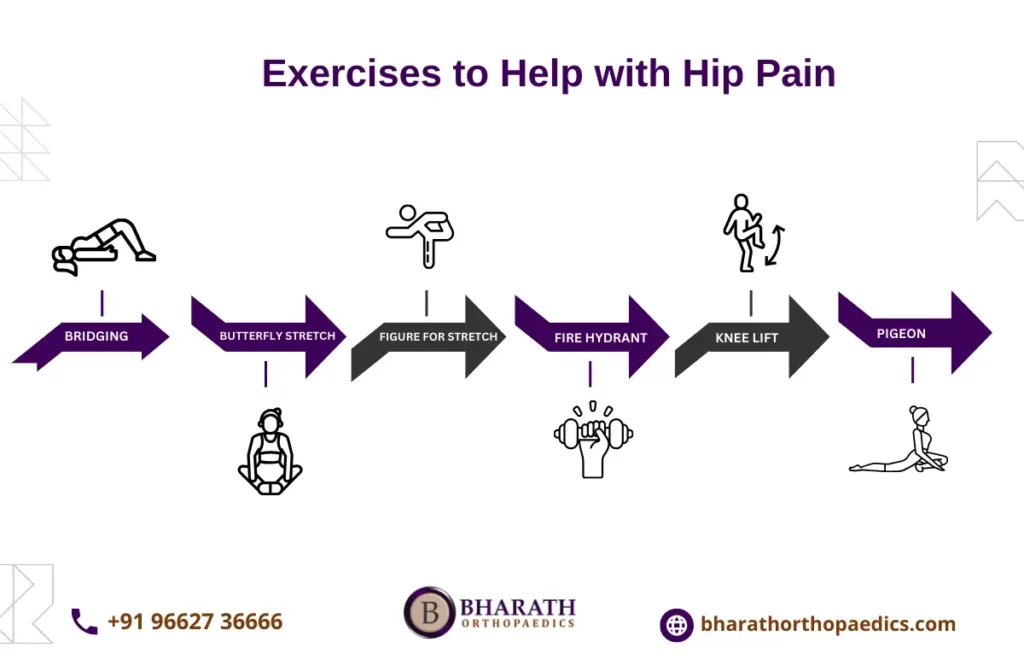
Hip bridges strengthen the glutes without loading the joint. Lie on your back, feet flat, and drive the hips upward. Hold briefly, then lower. Strong glutes help protect the hip long term.
Modified yoga (child’s pose, reclined butterfly, seated forward folds) can improve flexibility at low risk, provided extreme rotation poses are avoided.
Seated leg lifts are among the safest options for significant pain. Extend one leg from a chair and hold for a few seconds. This exercise is commonly used in hip replacement rehabilitation.
Clamshells with a resistance band build hip stability gently. Lying on your side with knees bent, lift the top knee and lower slowly.

Tips for Exercising With Hip Pain
- Warm up for 5 to 10 minutes before every session to improve joint lubrication and reduce injury risk.
- Follow the pain rule: mild discomfort (2 to 3 out of 10) is generally acceptable. Stop if pain rises to 4 or above, or worsens after exercise.
- Avoid overstretching. Favour controlled dynamic movement over prolonged static stretches at end range.
- Wear supportive footwear. Good cushioning reduces impact forces travelling from the foot up through the hip.
- Strengthen your core. A strong core reduces unnecessary stress on the hip. Pilates and seated stability exercises are good starting points.
- Adjust your sitting posture. Keep hips level with or slightly above knees and take short standing breaks every 30 to 45 minutes.
When to See a Doctor for Hip Pain
Seek a specialist assessment if you experience any of the following:
- Pain persisting for more than 2 to 4 weeks without improvement
- Hip pain that disrupts sleep
- Pain after a fall or direct trauma
- A clicking, locking, or giving-way sensation in the hip
- Significant loss of range of motion
- Swelling, redness, or warmth around the joint
At Bharat Orthopaedics, our specialists provide diagnosis-led care for a full range of hip conditions, from conservative management and physiotherapy referrals through to hip replacement surgery and post-operative rehabilitation. The right exercise plan starts with an accurate diagnosis.
Book a consultation with Dr. Bharat today.
Conclusion
Avoid deep squats, lunges, running, deadlifts, the leg press, the hip abductor machine, crunches, jumping, high-impact sports, and uneven terrain. Replace them with low-impact alternatives, warm up properly before every session, and stop if pain worsens. If symptoms persist beyond a few weeks, get a proper diagnosis before continuing. At Bharat Orthopaedics, we help patients find the safest path back to an active life.
This article is for general informational purposes only and does not constitute medical advice. Always consult a qualified orthopaedic specialist before starting or modifying an exercise programme.