
Living with rheumatoid arthritis can be physically and emotionally exhausting. The pain, stiffness, and swelling do not just affect your joints. They affect your sleep, your ability to work, and the small daily tasks most people take for granted.
Rheumatoid arthritis does not have a permanent cure, but that does not mean it cannot be managed well. With early diagnosis and the right treatment plan, most patients are able to reduce inflammation, protect their joints, and stay active for years.
This guide explains what rheumatoid arthritis treatment in Chennai involves, what to expect at each stage, and how to work with your doctor to build a plan that fits your life.
What is Rheumatoid Arthritis?
Rheumatoid arthritis is an autoimmune condition. That means the body’s immune system, which is supposed to protect you, mistakenly attacks the lining of your own joints. This lining is called the synovium. When it becomes inflamed, it causes the pain, swelling, and stiffness that people with RA experience.
This is different from the joint wear that comes with aging. Rheumatoid arthritis can affect people in their thirties and forties, sometimes younger. It often affects joints on both sides of the body at the same time, such as both wrists or both knees. In some patients it can also affect the skin, eyes, lungs, and heart over time.
The earlier it is diagnosed, the more that can be done to slow its progression.
How Rheumatoid Arthritis Progresses
Rheumatoid arthritis does not look the same in every patient. For some people it starts mildly and stays manageable for years. For others it moves quickly and causes significant joint damage without early treatment. Understanding how the disease typically progresses helps patients recognise when to seek care.
In the early stage, the joint lining becomes inflamed. You may notice morning stiffness that lasts longer than 30 minutes, mild swelling around the fingers, wrists, or knees, and a general feeling of fatigue. At this point joints are still intact and treatment can be very effective at slowing or stopping damage.
As the disease progresses to a moderate stage, inflammation becomes more persistent. X-rays may begin to show early joint changes. Movement becomes more limited and pain increases during daily activities.
In the severe stage, cartilage and bone inside the joint begin to break down. Deformity may become visible. Pain is more constant and affects sleep and daily function significantly.
In the most advanced cases, the joint may lose function almost entirely. At this point surgical options such as joint replacement may be the most effective path to restoring mobility and relieving pain.
Reaching out to a specialist early, before the disease advances, gives patients the widest range of treatment options and the best chance of a good long-term outcome.
Signs and Symptoms to Watch For
Rheumatoid arthritis often begins gradually. The earliest signs are easy to dismiss as general tiredness or minor joint aches. Knowing what to look for makes a real difference.
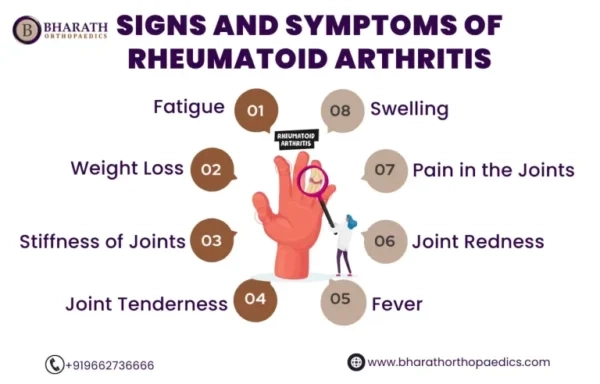
Morning stiffness that lasts more than 30 minutes is one of the most consistent early signs. The small joints of the hands, wrists, and feet are usually affected first. Joints may feel swollen, warm to the touch, and tender when pressed.
One pattern that helps doctors identify RA is symmetry. If the right wrist is painful and swollen, the left wrist is often affected too. This mirroring on both sides of the body is a characteristic feature of the condition.
Pain in RA often comes in episodes called flares, where symptoms worsen for a period before settling down. Between flares, some patients feel close to normal. Others have a more continuous level of discomfort.
Beyond the joints, rheumatoid arthritis can cause ongoing fatigue, a low-grade fever, and reduced appetite. These happen because the immune system remains active and produces inflammation throughout the body, not just in the joints.
If you are experiencing any of these symptoms regularly, an early consultation with an orthopaedic or rheumatology specialist is the right step.
What Causes Rheumatoid Arthritis?
The exact cause of rheumatoid arthritis is not fully understood. What is known is that the immune system begins to behave abnormally and attacks joint tissue it should be protecting. Several factors appear to contribute to this.
Genetics plays a role. If a close family member has rheumatoid arthritis, your risk of developing it is higher. This does not mean it is inevitable, just that the predisposition can be inherited.
Hormonal factors are also involved. Women develop rheumatoid arthritis significantly more often than men, which suggests hormones influence the immune response in ways that are still being studied.
Environmental triggers such as certain infections, prolonged exposure to cigarette smoke, and air pollution have been associated with triggering the onset of RA in people who are already predisposed to it.
Smoking in particular is one of the most clearly established risk factors. People who smoke have a higher risk of developing RA and tend to have a more severe disease course once diagnosed.
Who is Most at Risk?
Rheumatoid arthritis can develop in anyone, but certain groups are more likely to be affected:
- Women are two to three times more likely to develop RA than men
- The condition most commonly begins between the ages of 30 and 60, though it can start earlier or later
- People with a family history of RA or other autoimmune conditions carry a higher risk
- Smokers have a higher likelihood of developing the condition and tend to experience a more severe disease course
- People who are significantly overweight face a higher risk and more persistent symptoms
How Rheumatoid Arthritis is Diagnosed
There is no single test that confirms rheumatoid arthritis. Diagnosis is based on a combination of information gathered over a clinical assessment.
Your doctor will begin by asking about your symptoms in detail, how long they have been present, which joints are affected, and whether anyone in your family has had a similar condition. A physical examination follows, where the doctor checks for joint swelling, warmth, tenderness, and range of motion.
Blood tests are an important part of the process. Two markers are particularly useful. Rheumatoid factor and anti-CCP antibodies are proteins the immune system produces in RA. Elevated levels support a diagnosis, though some patients with RA test negative for both. Inflammatory markers such as CRP and ESR are also checked to measure how active the disease is.
Imaging helps assess joint damage. X-rays can show changes in bone and cartilage. MRI and ultrasound provide more detailed images of soft tissue inflammation and are useful for detecting early damage that X-rays may miss.
Early diagnosis matters because treatment started before significant joint damage occurs produces better long-term outcomes than treatment started later.
Treatment Options for Rheumatoid Arthritis in Chennai
The goal of treatment is to reduce inflammation, relieve pain, slow joint damage, and help patients stay as active as possible. Treatment is almost always a combination of approaches tailored to the individual.
Medication
Medication is the foundation of rheumatoid arthritis management. The choice of medication depends on how active the disease is, how long the patient has had symptoms, and how they respond over time.
Disease-modifying anti-rheumatic drugs, commonly called DMARDs, are the first line of treatment. They work by slowing the immune system’s attack on the joints. Methotrexate is the most commonly used DMARD and has decades of evidence behind it. These medications do not produce immediate results but work over weeks and months to reduce disease activity.
Biologic agents are a newer class of treatment that target specific parts of the immune system responsible for inflammation. They are typically used when DMARDs alone are not providing adequate control. Biologics are highly effective for many patients but require careful monitoring.
NSAIDs, which stands for non-steroidal anti-inflammatory drugs, help manage pain and reduce swelling. They provide symptom relief but do not slow the underlying disease process.
Corticosteroids such as prednisolone act quickly to reduce inflammation and are useful during flares or when starting a new treatment plan. They are generally used for short periods because of side effects with long-term use.
The right combination of medications is determined by a specialist based on individual assessment. There is no single best medicine for everyone with rheumatoid arthritis.
Physiotherapy
Physiotherapy plays an important role in maintaining joint flexibility and muscle strength. A physiotherapist designs an exercise programme suited to the patient’s current level of function and adjusts it as the disease changes. Techniques such as heat therapy, cold therapy, and TENS can also help manage pain between sessions.
Regular physiotherapy helps patients stay mobile, reduces stiffness, and supports independence in daily life.
Occupational Therapy
An occupational therapist helps patients adapt their daily activities to protect their joints. This may involve learning new ways to hold objects, using assistive devices such as jar openers or ergonomic grips, and making small changes to the home or workplace that reduce joint stress throughout the day.
Surgical Treatment
Surgery is considered when medications and therapy are no longer preventing joint damage or when joint function has deteriorated significantly. It is not a first step but an important option for patients at a more advanced stage.
Synovectomy involves removing the inflamed joint lining to reduce pain and slow further damage. It is most useful in earlier stages before the joint surface is extensively damaged.
Tendon repair addresses damage to the tendons around the joint, which can rupture or weaken in longstanding RA.
Joint fusion stabilises a joint by permanently joining two bones together. It eliminates pain in that joint and is used when preserving movement is less important than relieving pain.
Total joint replacement removes the damaged joint entirely and replaces it with an artificial one. For patients with advanced RA affecting the knee or hip, joint replacement can provide significant and lasting pain relief and restore the ability to walk and move independently.
Types of Rheumatoid Arthritis
Rheumatoid arthritis is not identical in every patient. Doctors classify it into types based on blood test results and how the disease behaves clinically.
- Seropositive rheumatoid arthritis is the more common type. Blood tests show specific antibodies, either rheumatoid factor or anti-CCP, or both. Patients with this type tend to have more persistent inflammation and a higher risk of joint damage without early treatment.
- Seronegative rheumatoid arthritis means the typical antibodies do not show up in blood tests, but the patient still has joint pain, swelling, and stiffness consistent with RA. Diagnosis in this case relies more heavily on symptoms, physical examination, and imaging. Some patients with seronegative RA have a milder disease course, but regular follow-up and treatment are still important.
- Juvenile idiopathic arthritis refers to inflammatory arthritis that begins before the age of 16. It requires specialist paediatric care because the disease can affect growth and development in ways that adult RA does not.
Complications of Rheumatoid Arthritis
Without adequate treatment, rheumatoid arthritis can affect more than just the joints. Long-term uncontrolled inflammation increases the risk of cardiovascular disease, including heart attack and stroke. Lung tissue can become inflamed or scarred over time. Bone density decreases, raising the risk of fractures. The medications used to treat RA can also affect immunity, making infections more likely.
Eye inflammation causing dryness and discomfort is common in some patients. Skin nodules, which are small firm lumps that form under the skin near joints, occur in a proportion of patients with seropositive RA.
These complications are not inevitable. Consistent treatment that keeps inflammation under control significantly reduces the risk of most of them.
Living Well With Rheumatoid Arthritis
A diagnosis of rheumatoid arthritis is not the end of an active life. Many patients, with the right treatment and some adjustments to daily habits, continue to work, exercise, travel, and do the things they value most.
Staying consistent with medication matters more than most patients initially realise. Stopping treatment when symptoms improve is one of the most common reasons RA flares and causes further damage. The medication is working precisely because you are taking it.
Diet does not cure rheumatoid arthritis, but it plays a supporting role. Foods rich in omega-3 fatty acids, such as oily fish, walnuts, and flaxseed, have anti-inflammatory properties. A diet built around vegetables, whole grains, and lean protein supports a healthy weight, which reduces mechanical stress on the joints.
Low-impact exercise such as swimming, cycling, and walking helps maintain joint mobility and muscle strength without putting excessive load on inflamed joints. Movement, done carefully and consistently, is protective rather than harmful for most RA patients.
Stress does not cause RA but it can trigger flares in some people. Finding ways to manage stress, whether through exercise, sleep, social connection, or professional support, is a genuine part of managing the condition.
Regular follow-up with your specialist allows treatment to be adjusted as the disease changes. RA is not static, and the plan that works well at one stage may need updating at another.
About Dr. Bharath Loganathan
Dr. Bharath Loganathan is a senior orthopaedic surgeon based in Chennai with over 20 years of experience in joint care, including the surgical management of advanced rheumatoid arthritis affecting the knee and hip. He holds an MS in Orthopaedics from Grant Medical College, Mumbai, an MRCS from the Royal College of Surgeons, Edinburgh, and completed advanced joint reconstruction fellowship training in the United States as a Ranawat Adult Joint Reconstruction Fellow and Rothman Ranawat Traveling Fellow.
For patients whose rheumatoid arthritis has reached the point where surgical intervention is being considered, Dr. Loganathan provides a thorough assessment and clear guidance on whether joint replacement or other surgical options are appropriate for their specific situation.
Bharath Orthopaedics in Kilpauk, Chennai, is open Monday to Saturday, 9:30 am to 8 pm, and Sunday, 10 am to 3 pm, with dedicated slots for outpatient consultations and surgical scheduling.
Conclusion
Rheumatoid arthritis is a long-term condition, but with early diagnosis and consistent care it can be managed effectively. The combination of the right medication, physiotherapy, and lifestyle support gives most patients a real chance at staying active and protecting their joints over time.
When the disease has caused significant joint damage, surgical options including joint replacement can restore mobility and relieve pain in ways that medication alone cannot.
If you are dealing with joint pain, morning stiffness, or swelling that has not been properly assessed, the right starting point is a consultation with a specialist who can give you an accurate diagnosis and a structured plan for long-term joint health.
Read also Rheumatoid Arthritis Foods to Avoid.