
A hamstring strain is one of the most common muscle injuries, affecting athletes and active individuals alike. Whether it happened during a sprint, a sudden change of direction, or even a simple misstep, the recovery process requires a structured and progressive approach. Returning to activity too soon is the most common reason hamstring strains become recurring problems.
This guide covers everything you need to know about hamstring strain recovery: the exercises, the stages, and the warning signs that indicate when to slow down.
Understanding Hamstring Strain
The hamstrings are a group of three muscles running along the back of the thigh: the biceps femoris, semitendinosus, and semimembranosus. They work together to bend the knee and extend the hip, making them essential for walking, running, climbing stairs, and most lower body movements.
A strain occurs when these muscles are stretched beyond their capacity, causing fibres to tear. Strains are graded by severity:
- Grade 1: Mild overstretching with minor fibre damage. Some tightness and discomfort, but walking is possible.
- Grade 2: Partial muscle tear. Noticeable pain, swelling, and reduced strength. Walking is affected.
- Grade 3: Complete muscle tear. Severe pain, significant bruising, and inability to use the leg normally. Requires medical assessment.
Most people deal with Grade 1 or Grade 2 strains, which respond well to structured rehabilitation.
Symptoms to Watch For
Hamstring injuries typically come on suddenly. Common signs include:
- A sharp or pulling pain at the back of the thigh, sometimes with a popping sensation at the moment of injury
- Swelling or bruising developing within a few hours
- Tenderness when pressing along the hamstring muscle
- Stiffness and tightness, especially after sitting or resting
- Weakness when trying to bend the knee or extend the leg
- Difficulty walking or bearing weight in more severe cases
If there is significant bruising extending toward the knee or buttock, or if bearing weight is not possible, a clinical assessment is recommended before starting any rehabilitation exercises.
The Three Phases of Hamstring Recovery
Recovery follows three broad phases, and the exercises appropriate for each phase are different. Skipping ahead too quickly is the most common reason for re-injury.
Phase 1: Acute Stage (Days 1 to 7)
The priority in the first week is protecting the injured tissue and managing inflammation. Follow the RICE principle: rest, ice, compression, and elevation. Avoid stretching or loading the hamstring during this phase, as pulling on inflamed, healing tissue slows recovery rather than speeding it up.
Gentle activity like short, flat walks is acceptable if pain-free, but nothing that causes discomfort in the back of the thigh.
Phase 2: Early Rehabilitation (Weeks 1 to 3)
Once acute inflammation settles, the focus shifts to restoring range of motion and beginning light muscle activation. Exercises at this stage should be gentle and pain-free throughout.
Phase 3: Strengthening and Return to Activity (Week 3 Onwards)
Progressive loading builds the strength and resilience needed to return to full activity. This phase takes longer than most people expect, and rushing it is what leads to the cycle of recurring strains.
Phase 1 and 2 Exercises: Gentle Activation
Isometric Hamstring Contraction (Wall Press)
Isometric exercises activate the muscle without moving the joint, making them safe in the early stages of recovery.
How to do it: Lie on your back with knees bent and feet flat against a wall. Press your heels gently into the wall without pushing your body away. Hold for 5 to 10 seconds, relax, and repeat.
- Sets/reps: 3 sets of 8 to 10 holds
- Frequency: Once or twice daily
- Stop if: You feel pain in the back of the thigh
Chair Press Isometric
How to do it: Sit upright in a chair with one foot tucked slightly under the front leg of the chair. Press your heel upward into the chair leg gently, as if trying to bend your knee further. Hold for 5 to 10 seconds and release.
- Sets/reps: 3 sets of 8 to 10 holds per side
- Frequency: Once or twice daily
Supine Heel Slide
How to do it: Lie on your back with both legs straight. Slowly slide the heel of the injured leg toward your buttock by bending the knee, then return to the starting position. Keep the movement slow and controlled.
- Sets/reps: 3 sets of 10 repetitions
- Frequency: Once daily
Phase 2 and 3 Exercises: Progressive Strengthening
Once the early exercises can be performed pain-free and reasonable range of motion has been recovered, begin introducing these progressive exercises.
Prone Knee Flexion
How to do it: Lie face down on a flat surface with legs straight. Slowly bend the knee of the injured leg, bringing the heel toward the ceiling as far as comfortable, then lower it back down with control.
- Sets/reps: 3 sets of 12 to 15 repetitions
- Progression: Add a light ankle weight as strength improves
Glute Bridge
Bridges are excellent for rebuilding both hamstring and gluteal strength, which work together to support the knee and pelvis.
How to do it: Lie on your back with knees bent and feet flat on the floor, hip-width apart. Press through your heels to lift your hips off the floor until your body forms a straight line from shoulders to knees. Hold for 2 seconds at the top, then lower slowly.
- Sets/reps: 3 sets of 10 to 12 repetitions
- Progression: Progress to single-leg bridges as strength improves
Standing Knee Flexion
How to do it: Stand on the uninjured leg for balance, holding a wall or chair if needed. Slowly bend the injured leg at the knee, bringing the heel toward the ceiling, then lower it with control. Focus on the eccentric (lowering) phase, as this is where the real strengthening happens.
- Sets/reps: 3 sets of 10 to 15 repetitions
- Frequency: Every other day to allow recovery between sessions
Straight Leg Hamstring Stretch
Begin gentle static stretching only when the muscle is no longer tender and the acute phase has fully passed.
How to do it: Stand facing a low surface such as a step or bench. Place the heel of the injured leg on the surface with the leg straight. Keeping your back straight and chest up, hinge forward from the hips until you feel a gentle stretch along the back of the thigh. Do not round the back or force the stretch.
- Hold: 20 to 30 seconds
- Sets: 3 repetitions per side
- Frequency: Once or twice daily
Nordic Hamstring Curl (Advanced)
This is one of the most evidence-supported exercises for hamstring injury prevention and later-stage rehabilitation. Introduce this only after building a solid base of strength from the earlier exercises.
How to do it: Kneel on a soft surface with your ankles secured under something fixed. Keeping your body straight from knees to head, slowly lower your torso toward the floor using your hamstrings to control the descent. Use your hands to catch yourself at the bottom, then push back up to the start.
- Sets/reps: 3 sets of 5 to 8 repetitions initially
- Note: Only introduce this when pain-free through the full range of the earlier exercises
Common Mistakes That Slow Recovery
Stretching too early. Stretching an acutely strained muscle in the first few days pulls on damaged fibres and increases inflammation. Wait until the acute phase has passed.
Returning to sport too quickly. The muscle may feel fine during walking but still lack the strength and resilience for sprinting or jumping. A pain-free walk does not mean a pain-free sprint.
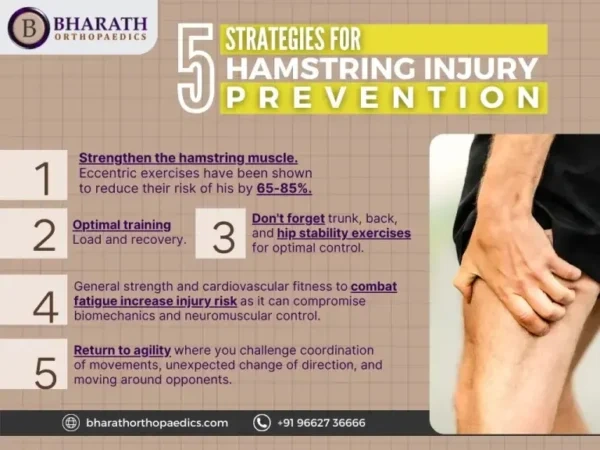
Skipping eccentric training. The hamstrings are most vulnerable when lengthening under load, which is the eccentric phase. Exercises that train this specifically, such as Nordic curls and the controlled lowering in standing knee flexion, are the most important for preventing re-injury.
Not addressing the cause. Hamstring strains often recur because underlying issues such as hip weakness, poor running mechanics, and inadequate warm-up were not addressed during recovery.
When to See a Specialist
Most Grade 1 and Grade 2 hamstring strains recover well with a structured home rehabilitation programme. A clinical assessment is recommended if:
- Pain is severe and normal walking is not possible
- Significant bruising or swelling developed rapidly after the injury
- Multiple hamstring strains have occurred on the same side
- Pain has not improved after 2 to 3 weeks of conservative management
- A pop was felt or heard at the moment of injury, followed by significant weakness
A Grade 3 tear or proximal hamstring avulsion, where the tendon pulls away from the bone at the sitting bones, requires specialist assessment and may need surgical repair.
Returning to Sport
Return to full activity is appropriate when:
- Full range of motion has been restored compared to the uninjured side
- Strength is at least 90% of the uninjured leg on testing
- Sprinting, changing direction, and jumping can be performed without pain or hesitation
- A progressive running programme has been completed without symptoms
A physiotherapist can help guide a structured return-to-sport protocol, including strength testing and sport-specific movement drills before returning to full training.
If knee pain is present alongside a hamstring strain, or if knee discomfort developed during recovery, the team at Bharath Orthopaedics in Chennai can assess the full picture. Read more about knee pain treatment in Chennai or physiotherapy for knee pain on our website.
For appointments, visit our contact page.
Read also Hip Pain Exercises To Avoid